
Myth as Instruction and Moral Technology
Fable is not just entertainment. It began life as instruction encoded in story.
In African civilisations, fable functioned as a primary knowledge technology. It carried law, ethics, cosmology, history, and social instruction in narrative form, allowing knowledge to travel safely across time, geography, and political threat.
Fable was not ornamental culture. It was infrastructure.
This page establishes Fable as the first component of the Bridgeworks: the civilisational architecture through which African knowledge was generated, transmitted, and preserved under conditions of rupture.
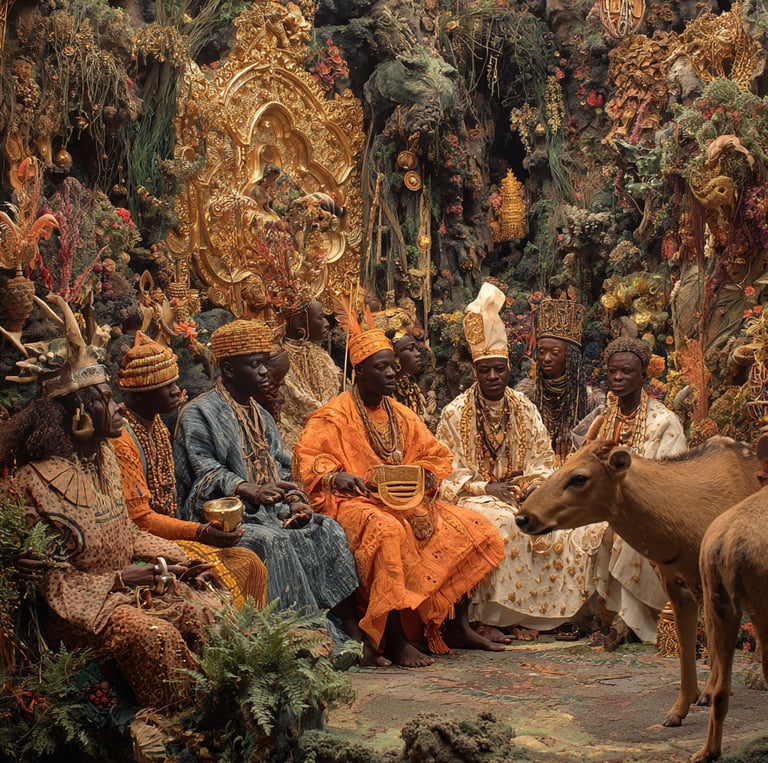
Fable as Civilisational Instruction
Fables are teaching systems. They embed rules of conduct, metaphysical law, and social consequence into narrative structures that can be remembered, retold, and adapted without losing their core logic.
In African contexts, fable was used to:
encode moral law without naming it directly
teach children and adults simultaneously
transmit political caution, spiritual warning, and ecological wisdom
conceal instruction under conditions of danger or surveillance
Fable allowed truth to circulate without presenting itself as doctrine.
This was not accidental. It was design.
What is often described as African “folklore” is not evidence of cultural ornament, but the surviving surface of a civilisational instructional system. Fable names the function of these narratives before they were reduced, extracted, or aestheticised.
Structural Ancestry and "African Origins"
What Fable Claims—and Does Not Claim
Fable does not claim that a specific African tale is the provable historical original of a specific European fairy tale. In most cases, that evidence does not exist—because African narrative systems were deliberately erased, fragmented, or never archived intact. European folklorists sanitised, Christianised, and nationalised stories that had already passed through multiple cultures. Oral transmission does not leave the paper trail European academia demands.
Fable does not say: "This is how the story really ended." That would be dishonest.
What Fable does say is this: the narrative technologies that make these stories work—the laws of transformation, taboo, consequence, and spirit logic—are African in origin, even when the stories themselves have been rewritten, relocated, and morally flattened.
Fable is not a claim of direct provenance. It is a claim of structural ancestry.
The Difference Between Plots and Laws
Structural ancestry asks different questions than European folklore studies. Not "who wrote it first" or "where was it written down," but rather: What kind of world does this story assume? What laws govern that world? What happens when those laws are broken? Who has power—gods, ancestors, nature, kings, spirits? What is punished? What is rewarded? What is feared? What is sacred?
When you ask these questions across global folklore, a pattern emerges that is unmistakable. European fairy tales are African-shaped stories retold inside non-African moral systems. They retain spirit logic, transformation rules, taboo structures, name-power, blood-debt, and ancestor consequence. But they lose African cosmology, African justice, African ritual context, and African ontology.
Fable restores the missing cosmology, not a missing script.
Why This Is Not Overreach
These elements are not European by origin. European Christianity does not explain spirit spouses. It does not explain animal-human boundary collapse, names as ontological keys, curses that travel bloodlines, forests as sentient moral agents, water as conscious and erotic, bargains that bind descendants, or knowledge as dangerous rather than virtuous.
African cosmologies do. Repeatedly. Across regions. Independently.
When the same mythic mechanics appear globally, but only one civilisation treats them as foundational rather than aberrant, that civilisation is the deeper source. Not because it "invented" the mechanics, but because it retained the cosmological framework that makes those mechanics legible.
What "African Origins" Actually Means
Fable does not claim "this exact story came from Africa." It claims "the narrative technology that makes this story intelligible comes from African world-models."
The retellings that appear within Fable are not presented as recovered originals. They are counter-colonial restorations. They ask: if this story were told inside an African moral universe—without Christian flattening, patriarchal sanitising, or Enlightenment moral closure—what would it actually do?
That is not invention. That is de-distortion.
Why the Darker Logic Matters
African fables lean into spirit spouses, revenge, witchcraft, possession, debt, and refusal of neat endings because African fables are not comfort stories. They are instruction manuals for surviving a sentient universe. European fairy tales became nursery tales. African fables were never for children alone. That difference matters.
The darkness is not cruelty. It is realism. In African cosmology, the world is not safe, balance is not guaranteed, and survival requires knowledge of consequence. Fable encodes that knowledge so it can travel, so it can endure, so it can protect.
Fable does not claim to recover lost African stories. It recovers the African laws of storymaking that Europe inherited, distorted, and forgot.




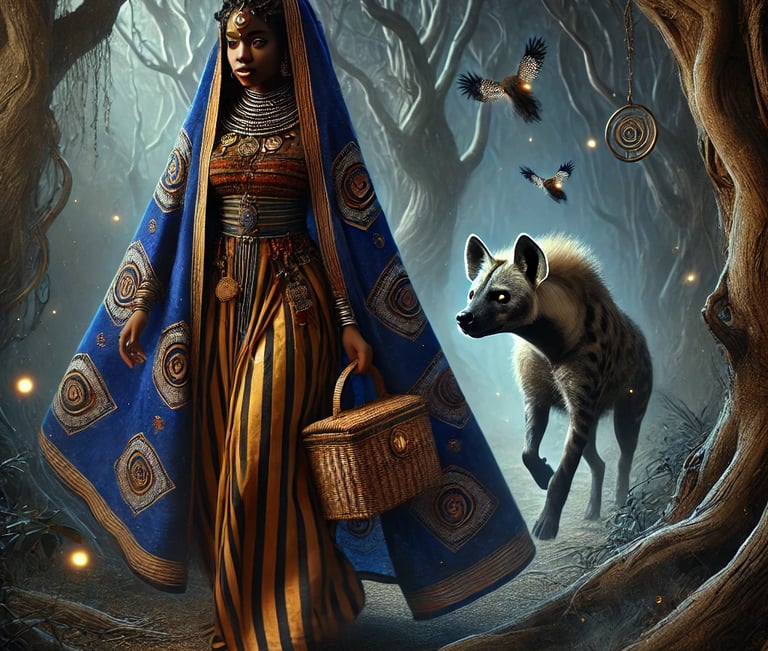
The Girl & the Hyena Spirit
European echo: Little Red Riding Hood
Shared motif: A young girl confronts a predatory force wearing a familiar face
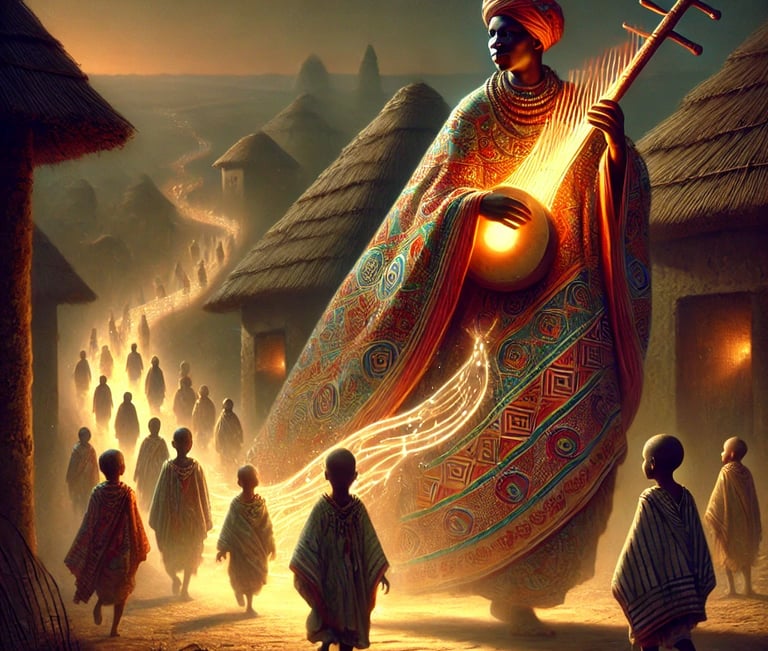
The Griot & The Lost Children
European equivalents: The Pied Piper (inverted morally) Shared motifs: Children lost due to adult failure or social breakdown
The Witch’s Sleeping Daughter
European equivalents: Sleeping Beauty Snow White Shared motifs: Female child placed in suspended state Maternal or elder female figure associated with danger
The Girl of the Ivory Mask
European echo: Snow White
Shared motif: Beauty, jealousy, and ritualized threat from an elder female figure

Story as Survival

The Eternal Stories of Africa
Uncovering African stories that teach law, ethics, and truth beyond folklore.
And the Origins of your favourite tales
Oral Intelligence as System, Not Pre-Literacy
(Band I: Story into Breath)
Civilisation begins in story, but story alone does not endure.
Fable creates instruction
Fable establishes the narrative logic. It encodes knowledge into allegory, parable, and symbolic action. Characters are not psychological portraits; they are moral functions. Outcomes are not entertainment; they are consequence.
Griot carries it
Knowledge was not left to chance circulation. Trained memory-holders preserved, performed, challenged, and corrected stories in public settings. Accuracy was communal, not individual. Memory was audited.
Score imprints it
Rhythm, repetition, cadence, and pattern transformed narrative into embodied memory. Through song, chant, timing, and ritual sequence, knowledge entered the body. This allowed instruction to survive migration, enslavement, exile, and generational rupture.
Together, Fable, Griot, and Score form a closed loop of transmission:
instruction → custodianship → embodiment.
This is oral intelligence as system, not absence.
Why These Three Form a Triad
Fable, Griot, and Score are inseparable because they solve three problems simultaneously:
Fable solves the encoding problem (how to compress law, ethics, cosmology into memorable form)
Griot solves the transmission problem (how to ensure accuracy across generations)
Score solves the durability problem (how to imprint knowledge into bodies so it survives displacement)
Remove any one, and the system fails. Fable without Griot becomes corrupted. Griot without Score cannot survive forced migration. Score without Fable has nothing to carry. Together, they form a complete transmission architecture.
The Fable–Griot–Score Triad
African oral traditions are often mischaracterised as evidence of absence: absence of writing, absence of archive, absence of system. This is structurally incorrect.
Fable operated as part of an oral intelligence system deliberately engineered for survivability. It was paired with custodianship and rhythm to ensure accuracy, continuity, and correction.
Story alone does not endure.
Story must be held, performed, and remembered.
This is where the wider architecture becomes visible.
Fable Under Conditions of Rupture
Fable is particularly effective under threat.
When written records are destroyed, banned, or seized, fable persists. When names cannot be spoken openly, allegory speaks for them. When power is dangerous to confront directly, story becomes shield and weapon.
This is partly why African fables survived the trans-Saharan extraction, enslavement across the Atlantic, colonial censorship, missionary suppression, postcolonial fragmentation
Fable is not fragile. It is adaptive.
Fable and the Mythic Foundations of Global Story
Many global fairy tales, moral stories, and allegorical traditions rely on mythic architectures that predate their European literary forms. These architectures include transformation as moral consequence, spirit intervention as law enforcement, taboo as structural boundary, and memory embedded in action rather than exposition. African fables retain these logics intact.
But the question remains: why identify these as African in origin?
Because these narrative mechanics are not explained by European cosmology. European Christianity does not account for spirit spouses who claim humans as lovers and punish betrayal across lifetimes. It does not explain animal-human boundary collapse where transformation is permanent and identity is fluid. It does not teach that names function as ontological keys—that to know a true name is to hold power over a being. It does not recognise curses that travel bloodlines, binding descendants to debts they did not incur. It does not position forests as sentient moral agents that witness, judge, and act. It does not treat water as conscious and erotic, capable of desire and vengeance. It does not build narrative worlds where bargains bind not just the individual but their children and their children's children. It does not frame knowledge as inherently dangerous rather than virtuous—something that corrupts, transforms, or kills the seeker.
African cosmologies do. Repeatedly. Across regions. Independently.
When the same mythic mechanics appear globally but only one civilisation treats them as foundational rather than aberrant, that civilisation holds the deeper cosmological framework. This is not a claim that Africa "invented" these mechanics. It is a recognition that African narrative systems retained the cosmological architecture that makes these mechanics legible, while European retellings preserved the mechanics but discarded the worldview that explained them.
European fairy tales are African-shaped stories retold inside non-African moral systems. They keep the transformation rules, the taboo structures, the spirit logic, the consequences. But they lose the cosmology that justified those rules. They lose the ritual context that governed when and how those rules applied. They lose the ontology that made spirits, ancestors, and nature co-equal actors in moral drama.
This work does not claim identical plots or preserved originals. It identifies origin structures: the narrative technologies that made later global stories possible. If later tales are adaptations, African fables preserve the earlier structural logics. This does not mean all stories came from Africa. It means African narrative systems remained intact where others were disrupted, making them uniquely valuable for studying how story encodes law, memory, and instruction.
What Fable Is - and Is Not
Fable is not folklore.
It is not decorative tradition or childish story.
Fable is not pre-history.
It is not what exists before writing appears.
Fable is not metaphor alone.
It is instruction encoded for survivability.
Fable is a civilisational technology: a method for governing behaviour, transmitting law, and preserving memory when other systems fail.


Fable Within the Bridgeworks
Fable sits at the point of origin within the Bridgeworks architecture. It initiates the flow of knowledge that later becomes encoded through script, symbol, object, science, and seed.
Without Fable, there is no instruction to preserve.
Without instruction, there is no civilisation to sustain.
Fable is where memory first learns how to breathe, and where African civilisation begins to speak. Without Fable, there is no instruction to preserve. Without instruction, there is no civilisation to sustain. Fable is not the beginning of decoration. It is the beginning of design.
Why the Fable–Griot–Score Triad Matters Today
We live in an era of institutional collapse, algorithmic misinformation, and fragmented memory. Digital archives disappear. Institutions lose credibility. Truth fractures. The Fable–Griot–Score Triad offers a proven alternative: knowledge systems designed to survive without centralized authority, permanent records, or institutional backing. Instruction encoded in story, verified by community, embodied in practice.
This is a blueprint for resilience when permanence cannot be guaranteed.
Frequently asked questions
Sources & Further Reading for Fable
This page synthesizes scholarship on African narrative systems, oral tradition, folklore studies, comparative mythology, and diaspora continuity. The sources below are organized thematically to support verification and further research.
African Narrative Systems & Oral Tradition
Okpewho, Isidore. African Oral Literature: Backgrounds, Character, and Continuity. Bloomington: Indiana University Press, 1992.
Foundational study establishing African oral tradition as systematic knowledge transmission, not pre-literacy.
Scheub, Harold. The African Storyteller: Stories from African Oral Traditions. Dubuque: Kendall/Hunt, 1990.
Comprehensive documentation of African narrative structures, performance contexts, and moral instruction systems.
Finnegan, Ruth. Oral Literature in Africa. Oxford: Oxford University Press, 1970.
Early comprehensive survey establishing the complexity, structure, and social functions of African oral traditions.
Diop, Cheikh Anta. The African Origin of Civilization: Myth or Reality. Chicago: Lawrence Hill Books, 1974.
Establishes African civilisational achievements and knowledge systems often erased or misattributed.
Fable as Instruction & Moral Technology
Bascom, William. African Folktales in the New World. Bloomington: Indiana University Press, 1992.
Traces continuities of African narrative structures across the diaspora, documenting survival and adaptation.
Pelton, Robert D. The Trickster in West Africa: A Study of Mythic Irony and Sacred Delight. Berkeley: University of California Press, 1980.
Analysis of African trickster narratives as philosophical and moral instruction systems.
Courlander, Harold. A Treasury of African Folklore. New York: Marlowe & Company, 1996.
Extensive collection of African narratives with contextual analysis of their instructional functions.
Comparative Mythology & Structural Ancestry
Propp, Vladimir. Morphology of the Folktale. Austin: University of Texas Press, 1968.
Structural analysis of narrative functions—useful for understanding how African narrative mechanics appear globally.
Thompson, Stith. The Folktale. Berkeley: University of California Press, 1977.
Comprehensive study of global folktale types and motifs, providing comparative framework.
Zipes, Jack. Breaking the Magic Spell: Radical Theories of Folk and Fairy Tales. Austin: University of Texas Press, 1979.
Analysis of how fairy tales encode social power and how European sanitisation distorted earlier forms.
Warner, Marina. From the Beast to the Blonde: On Fairy Tales and Their Tellers. London: Chatto & Windus, 1994.
Examines transformation of oral traditions into literary forms and what was lost in translation.
African Cosmology & Worldview
Mbiti, John S. African Religions and Philosophy. 2nd ed. Oxford: Heinemann, 1990.
Comprehensive overview of African cosmological systems that underpin narrative structures.
Opoku, Kofi Asare. West African Traditional Religion. Accra: FEP International, 1978.
Documents spirit logic, ancestor interaction, and taboo structures foundational to African fables.
Ray, Benjamin C. African Religions: Symbol, Ritual, and Community. 2nd ed. Upper Saddle River: Prentice Hall, 2000.
Analysis of how African religious systems encode law, ethics, and social order.
Diaspora Continuity & Transformation
Hurston, Zora Neale. Mules and Men. New York: Harper & Row, 1935.
Ethnographic documentation of African American folklore and narrative traditions as survival systems.
Levine, Lawrence W. Black Culture and Black Consciousness: Afro-American Folk Thought from Slavery to Freedom. Oxford: Oxford University Press, 1977.
Documents how African narrative systems adapted under enslavement while retaining core structures.
Dundes, Alan (ed.). Mother Wit from the Laughing Barrel: Readings in the Interpretation of Afro-American Folklore. Jackson: University Press of Mississippi, 1990.
Collection examining African American folklore as continuation of African narrative technologies.
Oral Intelligence Systems
Vansina, Jan. Oral Tradition as History. Madison: University of Wisconsin Press, 1985.
Establishes oral tradition as reliable historical record when understood within verification systems.
Goody, Jack. The Interface Between the Written and the Oral. Cambridge: Cambridge University Press, 1987.
Challenges oral/literate binary, showing oral systems as parallel technologies, not precursors.
Ong, Walter J. Orality and Literacy: The Technologizing of the Word. London: Methuen, 1982.
Theoretical framework for understanding oral intelligence as distinct cognitive and social technology.
The Fable–Griot–Score Triad
Hale, Thomas A. Griots and Griottes: Masters of Words and Music. Bloomington: Indiana University Press, 1998.
Documents custodianship functions (Griot) that preserved narrative instruction (Fable).
Chernoff, John Miller. African Rhythm and African Sensibility. Chicago: University of Chicago Press, 1979.
Examines how rhythm (Score) functions as memory technology embedding narrative instruction.
Bridgeworks Context
This framework builds on but extends beyond the above sources. The Bridgeworks positions Fable not as isolated folklore but as the instructional origin point of African civilisational memory, connecting to Griot (custodianship), Score (embodiment), and the entire knowledge architecture, is the branchild of Chinenye Ikwuemesi, within Afrodeities.
For broader Bridgeworks context, see related pillar pages on Griot, Score, Spell, Sigil, Script, and Memorabilia.
"The Bridgeworks" is an original civilisational framework developed by Chinenye Egbuna Ikwuemesi within Afrodeities.
Unearthing Africa’s myths, history, and stories together.
© 2024. All rights reserved.
© Chinenye Egbuna Ikwuemesi 2025.
All rights reserved.
The Afrodeities Codex and all associated titles, stories, characters, and mythologies are the intellectual property of the author. Unauthorized use is strictly prohibited.
Goddesses