
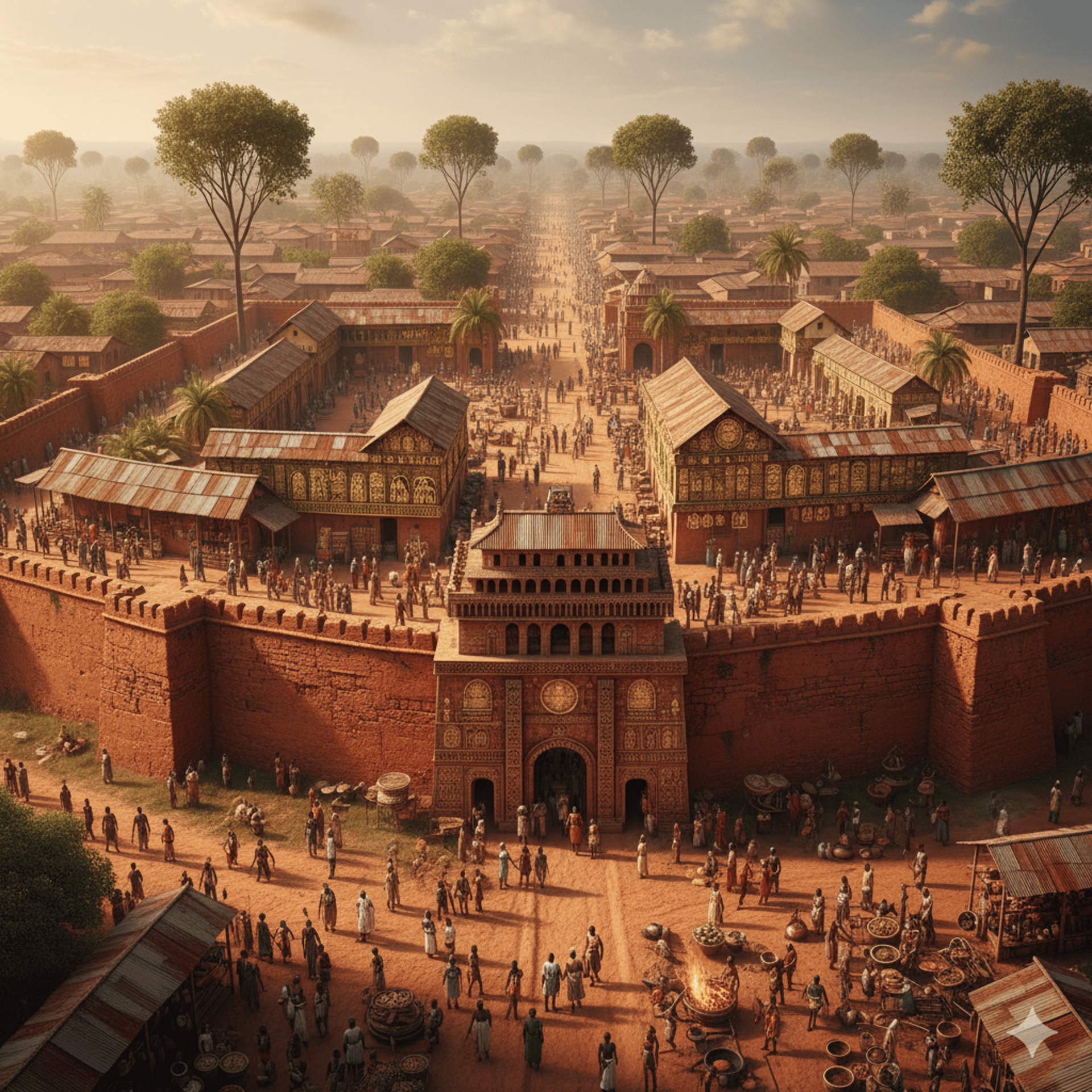
Benin City: The African Capital Europe Burned
Remembering the 1897 fire that changed a kingdom forever
Ashes
Shadows of Benin City’s lost splendor


Remembering Benin's Legacy
by Chinenye Egbuna Ikwuemesi
In 1897, a British punitive expedition marched into Benin City, the capital of the Benin Kingdom in what is now southern Nigeria, burned it to the ground, looted everything of value that the fire had not already destroyed, and sent the objects back to London. The bronzes, the ivories, the royal regalia, the altar pieces, the commemorative heads, went into the collections of the British Museum, the Pitt Rivers Museum, the Horniman Museum, and eventually into institutions across Europe and North America. Several thousand objects in total. The city they came from was left in ash.
The objects are now among the most celebrated works of African art in the world. Their technical sophistication, the lost-wax bronze casting of extraordinary precision, the carved ivory of extraordinary refinement, the documentary brass plaques that recorded the history and ceremonial life of the Benin court across centuries, is beyond serious dispute. They are recognised by the institutions that hold them as masterworks. The question of how they came to be in those institutions, and what the answer to that question requires, is rather more contested.
What Benin Was
The Kingdom of Benin, which should not be confused with the modern Republic of Benin to its west, was one of the oldest and most sophisticated states in West Africa, with a history of centralised rule extending back to at least the eleventh century CE and an artistic tradition of bronze and ivory work that began no later than the thirteenth century. Its capital, Benin City, was at its height one of the most impressive urban centres in the world.
The first Portuguese visitors arrived in 1485 and their accounts are worth reading carefully, because they are the testimony of people who had seen most of the major cities of Europe and were not easily impressed. They described a city of broad, well-ordered streets. They described a royal palace of immense extent whose interior courtyards and galleries were supported by wooden pillars covered in cast bronze plaques depicting the history of the kingdom. They described a people who were well-dressed, well-governed, and engaged in a sophisticated commerce that extended across the region. One Portuguese account compared Benin City favourably with Lisbon.
The city was not a collection of huts. It was a capital.
The Walls
The earthwork walls surrounding Benin City and its surrounding kingdom, the system of ramparts and moats whose construction began around 800 CE and continued over the following centuries, constitute one of the largest human construction projects in pre-industrial history. The archaeologist Patrick Darling, who spent years mapping the system in the 1970s, calculated that the total length of the earthworks exceeded sixteen thousand kilometres, and that the total volume of earth moved in their construction was approximately one hundred times the volume of the Great Pyramid at Giza.
The New Scientist described them in 1974 as the world's largest earthworks carried out prior to the mechanical era. They are, by linear measurement, four times the length of the Great Wall of China. They enclosed not just the capital but a network of settlements across the Benin Kingdom, a landscape of organised habitation and agriculture managed by the state. The engineering required to plan, execute, and maintain a system of this scale over several centuries represents a sustained organisational capacity that most human societies have never achieved.
These walls are not in the history books. The Great Wall of China is in the history books.
The Bronzes
The Benin bronzes, produced by the royal guild of bronze casters over several centuries, represent one of the great artistic and technical achievements of the pre-industrial world. The lost-wax casting technique used by the Benin smiths, in which a wax model is encased in clay, the wax melted out, and the resulting mould filled with molten bronze, produces castings of exceptional detail and precision. The Benin smiths worked at a scale and level of finish that European bronze casters of the same period could not match.
The brass plaques, of which roughly nine hundred survive in collections around the world, are not merely decorative. They are historical documents. Produced from the sixteenth to the seventeenth century to record the ceremonial and political life of the Benin court, they depict kings, warriors, court officials, Portuguese traders, and ritual events in a narrative visual language that, once understood, provides a detailed account of Benin history across several centuries. They are the written record of a kingdom, executed in metal because metal endures.
The Punitive Expedition of 1897
The British punitive expedition that destroyed Benin City in February 1897 was triggered by the killing of a British trade delegation the previous month. The delegation, led by Acting Consul General James Phillips, had been attempting to enter Benin City during the Igue festival, a period during which the Oba had specifically requested that foreigners not approach the city, on a mission that was explicitly intended to depose the Oba and open the kingdom to British commercial control. The Benin Kingdom's response to an armed advance during a sacred festival, in the context of increasing British pressure on its sovereignty, was to stop the delegation by force.
The British response was disproportionate in a manner that appears less like a punitive measure and more like a premeditated seizure. A force of over twelve hundred men was assembled. Benin City was taken, burned, and looted over several days. The Oba, Ovonramwen Nogbaisi, was captured, tried, and exiled to Calabar, where he died in 1914. The kingdom was incorporated into the British Niger Coast Protectorate.
The looted objects were sold at auction in London within weeks. Some went to private collectors. Most went to museums. The British Museum acquired several hundred pieces immediately and has continued to acquire Benin objects in the market since. The legal and ethical question of what institutions that hold objects acquired through colonial violence are required to do with them has been under serious discussion for decades and has produced, from most institutions, a great deal of discussion and very little return.
What Remains
Benin City is a living city. The Benin Kingdom, though no longer a sovereign state, maintains its institutions, its royal court, and its cultural traditions. The current Oba, Ewuare II, who ascended to the throne in 2016, governs a community that is the direct continuity of the kingdom whose capital was burned in 1897. The royal guild of bronze casters still works. The artistic tradition is not dead. It was not destroyed in 1897. It was interrupted, looted, and diminished, but not ended.
The case for the return of the Benin bronzes is not sentimental. It is legal, ethical, and historical. The objects were taken by force from a sovereign state that Britain had illegally invaded and destroyed. Their presence in European and American museums is the material evidence of that crime, displayed under lighting chosen to make it beautiful. The beauty is real. The crime is also real. The two facts sit in the same room, and have sat there for a hundred and twenty-five years, waiting for the institutions that benefit from the theft to decide what honesty requires of them.
The walls are overgrown. The bronzes are in Berlin. The Oba is still in Benin. The record is recoverable.
This article is part of the If Africa Ruled The World codex, a canon of corrective African civilisational history developed by the Afrodeities Institute. Chinenye Egbuna Ikwuemesi is a mythologist, scholar, and author of Nigerian Mythology: The Shadow Sky. Enquiries from editors, programmers, and conference organisers are welcome at afrodeities.org.
Related reading: Great Zimbabwe: Who Really Built It. Timbuktu and the Songhai Empire: Africa's Age of Enlightenment.
"The Bridgeworks" is an original civilisational framework developed by Chinenye Egbuna Ikwuemesi within Afrodeities.
Unearthing Africa’s myths, history, and stories together.
© 2024. All rights reserved.
© Chinenye Egbuna Ikwuemesi 2025.
All rights reserved.
The Afrodeities Codex and all associated titles, stories, characters, and mythologies are the intellectual property of the author. Unauthorized use is strictly prohibited.
Goddesses